Showing posts with label cities. Show all posts

Monday, July 21, 2008

Africa’s Women Last and Least in Food Crisis


Africa’s Women Last and Least in Food Crisis
by Kevin Sullivan

0720 04 1OUAGADOUGOU, Burkina Faso -
After she woke in the dark to sweep city streets, after she walked an
hour to buy less than $2 worth of food, after she cooked for two hours
in the searing noon heat, Fanta Lingani served her family’s only meal
of the day.

First she set out a bowl of corn mush, seasoned with tree leaves,
dried fish and wood ashes, for the 11 smallest children, who tore into
it with bare hands.

Then she set out a bowl for her husband. Then two bowls for a dozen
older children. Then finally, after everyone else had finished, a bowl
for herself. She always eats last.

A year ago, before food prices nearly doubled, Lingani would have
had three meals a day of meat, rice and vegetables. Now two mouthfuls
of bland mush would have to do her until tomorrow.

Rubbing her red-rimmed eyes, chewing lightly on a twig she picked
off the ground, Lingani gave the last of her food to the children.

“I’m not hungry,” she said.

Mealtime conspires against women
In poor West African nations such as Burkina Faso, mealtime conspires
against women. They grow the food, fetch the water, shop at the market
and cook the meals. But when it comes time to eat, men and children eat
first, and women eat last and least.

Soaring prices for food and fuel have pushed more than 130 million
poor people across vast swaths of Africa, Asia and Latin America deeper
into poverty in the past year, according to the U.N. World Food
Program. But while millions of men and children are also hungrier,
women are the hungriest and skinniest. Aid workers call malnutrition
among women one of the most notable hidden consequences of the food
crisis.

“It’s a cultural thing,” said HervĂ© Kone, director of a group that
promotes development, social justice and human rights in Burkina Faso.
“When the kids are hungry, they go to their mother, not their father.
And when there is less food, women are the first to eat less.”

A recent study by the aid group Catholic Relief Services found that
many people in Burkina Faso are now spending 75 percent or more of
their income on food, leaving little for other basic needs.

Pregnant women and young mothers are forgoing medical care. More
women are turning to prostitution to pay for food. And more families
are pulling children — especially girls — out of school, unable to
afford fees and clothes.

But perhaps the most pervasive effect of the growing global crisis
is the ache in the stomachs of millions of poor women such as Fanta
Lingani.

Sweeping for pennies
Lingani, who sleeps on a concrete floor, began one recent day at 4 a.m.
and dressed quietly in the dark. All around her, children slept on the
cracked floor under a tin roof, common conditions in a country that
ranks 176th out of 177 on the U.N. Human Development Index.

A year ago, Lingani might have started a small fire to boil herself a cup of weak coffee. But even that is now too expensive.

Such sacrifices led to food riots in February in Ouagadougou, the
capital, and towns across the country. Hundreds of people were arrested
after they set fires and smashed government buildings to protest rising
prices. But for Lingani, the struggle is quieter, and harder by the
day, and it starts before the sun comes up.

Lingani, who said she is about 50, walked across the dirt courtyard
past the two-room hut where her husband was sleeping in his own double
bed, with a thick mattress. The dirt street outside was muddy and
steamy from an overnight rain shower.

After a half-hour walk on the black-dark streets, she reported for
work and pulled on the long green smock of the Green Brigade, a city
program that pays poor women the equivalent of about $1.20 a day to
sweep streets two mornings a week.

Lingani picked up a pair of small straw brooms and pushed a
wheelbarrow onto a wide, deserted avenue. In the orange haze of
streetlights, she bent over at the waist, so far that her bottom was
higher than her head, and started pushing red dust into little piles.

The “shssssh shssssh” of her sweeping was the only sound, except for
the crowing of a few roosters and occasional laughter from men at an
all-night bar down the road.

She worked a section of road about 150 yards long, while a dozen
others in the all-female brigade swept along. A tanker truck sped down
the street, kicking up a cloud of dust into her face and blowing away
her little piles. She coughed, pulled her pink head scarf across her
face and swept the same dust all over again.

Lingani swept until the sun came up, pushing her piles onto a small
metal dish, then dumping them into a wheelbarrow and finally into a
pothole on an unpaved side street.

By 7 a.m., she’d finished her section. But she had to wait an hour
for a male supervisor to show up and check her work. In two weeks, she
would get her monthly pay of less than $10.

‘The job of women’
Lingani walked a half hour back to her house, where her huge family was
starting to stir. She took off her smock and picked up a green plastic
basket about the size of a shoebox.

Market time. She and one of her two “co-wives,” Asseta Zagre, do the
shopping on alternate days. Their husband’s other wife, the senior of
the three, is nearly blind and can’t do chores anymore.

Polygamy is common in much of Africa. In this household, the
patriarch is Hamado Zorome, 68, a retired police officer whose pension
is the family’s main income — but he doesn’t tell his wives how much he
gets.

The pension of a mid-level civil servant is probably modest in
Burkina Faso, where the United Nations says nearly 72 percent of the
country’s 15 million people live on less than $2 a day.

Zorome also collects a “tip” of 60 cents from each of his two
working wives when they get their monthly pay, which he uses to buy the
kola nuts he likes to chew.

Lingani and Zagre, who also sweeps streets, said Zorome doles out
small amounts of money for them to buy staples such as cornmeal. But
the bulk of the family’s meals are paid for out of the wives’ sweeping
wages.

As she prepared to leave for the market, Lingani kept bending over
and rubbing her ankles and feet. She said they hurt from sweeping for
so long. She has never weighed herself, but she said she can feel a
significant loss in her weight and strength in the past year.

Last month’s sweeping money was already gone. So she went to her
husband, who handed her about $2.50 for groceries. He told her to spend
no more than about 75 cents and save the rest for another day.

“Women are born with this job” of feeding the family, Lingani said,
as she walked around puddles and past goats tied to trees. “The man has
to have his share. And we have to make sure the kids have their share.
So we eat less.”

Lingani said none of the older boys in the family has a steady job,
since work is hard to come by in this poor city. So, she said, the boys
mostly spend their days doing odd jobs or playing soccer. What little
money they earn they tend to spend on food and beer for themselves.

“A man can never sit at home. They are always out somewhere,” Lingani said. “They don’t do anything. They don’t help.”

Lingani walked past small stands where women were selling fruit or
water, assisted by small girls. A few men sold bags or charcoal, but
most were sitting in the shade and talking.

“Men and women should fight together for the children,” Lingani
said. “But if the men won’t do that, the women have to fight alone.”

Zorome, Lingani’s husband, said that men don’t help with shopping
and cooking because “that is the job of women.” Like many men
interviewed here, he said African culture clearly defines roles for
men, who work outside the house, and women, who manage children and
meals.

He said that men are willing to work but that jobs are scarce. He
would prefer it if his wives didn’t have to sweep streets, but “life is
much more expensive now.”

“Last year, we could eat well, but now, forget it,” he said. “My
sons don’t work, so it’s up to me to feed 25 people. That’s why the
women sweep. We don’t have anything, so they have to work. That’s life.”

Ugly math
On her way to the market, Lingani explained the ugly math: A year ago,
she could feed her entire family a nutritious meal of meat and
vegetables and peanut sauce for about 75 cents. But now the family gets
much lower-quality food for twice the price.

She said the cost of six pounds of cornmeal has risen from 75 cents
to $1.50. A kilogram — 2.2 pounds — of rice cost 60 cents last year and
costs a little more than $1 now. Other basics such as salt and cooking
oil have also doubled in price.

Fuel costs have more than doubled for trucks that haul food to landlocked Burkina Faso, helping keep food prices high.

Beef or goat meat is now so expensive — about $1.20 for a tiny
portion — that the family has given up meat completely, eating cheap
dried fish instead. Rather than seasoning their sauces with vegetables
and peanuts, they now use the tough leaves of baobab trees, the gnarly
giants that flourish here in the dry lands south of the Sahara.

To soften the sour taste of the leaves, Lingani mixes in potash, a
paste made by boiling down water strained through ashes from wood fires.

“In the past, our money would last the whole month. We might even
have some left over,” Lingani said. “But now as soon as it arrives, we
spend it.”

Dinner happens only if there is a bit of food left over from lunch. Even then, she said, there is rarely enough left for women.

“When the children ask for food, we have to give it to them,” she said. “We’re mothers.”

Never enough
“Are you sure you don’t want more?” the vegetable vendor asked Lingani. “Is that enough for your family?”

Lingani, standing in a crowded neighborhood market, had just asked the woman for 30 cents worth of baobab leaves.

“No, it’s fine,” Lingani said, handing over a few coins.

The vendor shrugged and stashed the coins under a burlap sack of
tomatoes covered with a beard of small flies. She handed Lingani back
some change, which she counted carefully.

At the next stall, Lingani bought four small onions. As she turned
to leave, the seller tossed in a fifth with an understanding smile.
Lingani caught her eye and thanked her.

Moving through the churning mass of people, Lingani bought a bag of
dried fish, a small plastic bag of salt, two small cubes of beef
bouillon and a bag of potash, the paste made from ashes.

In 10 minutes, her shopping was done. She had spent double her budget of 75 cents.

After the half-hour walk home, with the temperature already above
90, Lingani and Zagre started plucking the baobab she bought at the
market, saving the leaves and throwing away the thick stems.

For an hour, the two women methodically pounded the rough leaves in
a wooden bowl, then dumped them into a pot boiling over a wood fire.
Then Lingani added the dried fish and some of the ash flavoring.

“Of course we would prefer something else,” she said. “But it’s the
cheapest thing we can buy, and we can afford enough to feed everybody.”

Two hours after she started cooking, Lingani scooped out six bowls
of flavorless food. The first was for Zorome, delivered to his hut. He
ate it alone, then said he felt as though he needed a nap.

Others were set aside to be shared by the children.

The last bowl, slightly larger than Zorome’s, was to be shared by 10
people: Lingani, Zagre and eight small grandchildren. Lingani took two
bites before letting five hungry toddlers finish her food.

Near the front gate, half a dozen of the children sat in a circle,
playing a game. They had built a play fire out of pieces of bark. On
top of it they had placed a little plastic cup, overflowing with street
garbage: onion skins and bits of rotting leaves.

They were pretending to cook.

“We’re cooking rice with meat!” said a beaming Ousmane, 6, the head chef.

His father, Zorome, watched the game and laughed. He was asked if he
would eat again today. Yes, he said, Lingani would make him a little
rice or porridge for dinner that night.

Nearby, his daughters and granddaughters heard him and exploded.
“What are you talking about?” they said. “Why are you saying that? We
have no food.”

Zorome smiled sadly and admitted his lie.

“When we have food one day, we have to tighten our belt the next,”
he said. “But it is very hard for a man to admit when things are not
good.”

Lingani was still sitting next to her empty food bowl. She had
stopped the children from finishing one last lump of corn mush, about
the size of her fist.

“The small children will be crying in a couple of hours, so we have
to save it,” she said. Her voice was small and soft, and she didn’t
look up from the red dirt. She said she felt “very sad.”

“I’m thinking too much,” she said.

Thursday, June 26, 2008

Living on the Ice Shelf

Published on Thursday, June 26, 2008 by TomDispatch.com
Living on the Ice Shelf, Humanity's Meltdown

by Mike Davis

1. Farewell to the Holocene

Our world, our old world that we have inhabited for the last 12,000 years, has ended, even if no newspaper in North America or Europe has yet printed its scientific obituary.

This February, while cranes were hoisting cladding to the 141st floor of the Burj Dubai tower (which will soon be twice the height of the Empire State Building), the Stratigraphy Commission of the Geological Society of London was adding the newest and highest story to the geological column.

The London Society is the world's oldest association of Earth scientists, founded in 1807, and its Commission acts as a college of cardinals in the adjudication of the geological time-scale. Stratigraphers slice up Earth's history as preserved in sedimentary strata into hierarchies of eons, eras, periods, and epochs marked by the "golden spikes" of mass extinctions, speciation events, and abrupt changes in atmospheric chemistry.

In geology, as in biology or history, periodization is a complex, controversial art and the most bitter feud in nineteenth-century British science — still known as the "Great Devonian Controversy" — was fought over competing interpretations of homely Welsh Graywackes and English Old Red Sandstone. More recently, geologists have feuded over how to stratigraphically demarcate ice age oscillations over the last 2.8 million years. Some have never accepted that the most recent inter-glacial warm interval — the Holocene — should be distinguished as an "epoch" in its own right just because it encompasses the history of civilization.

As a result, contemporary stratigraphers have set extraordinarily rigorous standards for the beatification of any new geological divisions. Although the idea of the "Anthropocene" — an Earth epoch defined by the emergence of urban-industrial society as a geological force — has been long debated, stratigraphers have refused to acknowledge compelling evidence for its advent.

At least for the London Society, that position has now been revised.

To the question "Are we now living in the Anthropocene?" the 21 members of the Commission unanimously answer "yes." They adduce robust evidence that the Holocene epoch — the interglacial span of unusually stable climate that has allowed the rapid evolution of agriculture and urban civilization — has ended and that the Earth has entered "a stratigraphic interval without close parallel in the last several million years." In addition to the buildup of greenhouse gases, the stratigraphers cite human landscape transformation which "now exceeds [annual] natural sediment production by an order of magnitude," the ominous acidification of the oceans, and the relentless destruction of biota.

This new age, they explain, is defined both by the heating trend (whose closest analogue may be the catastrophe known as the Paleocene Eocene Thermal Maximum, 56 million years ago) and by the radical instability expected of future environments. In somber prose, they warn that "the combination of extinctions, global species migrations and the widespread replacement of natural vegetation with agricultural monocultures is producing a distinctive contemporary biostratigraphic signal. These effects are permanent, as future evolution will take place from surviving (and frequently anthropogenically relocated) stocks." Evolution itself, in other words, has been forced into a new trajectory.

2. Spontaneous Decarbonization?

The Commission's coronation of the Anthropocene coincides with growing scientific controversy over the 4th Assessment Report issued last year by the Intergovernmental Panel on Climate Change (IPCC). The IPCC is mandated to establish scientific baselines for international efforts to mitigate global warming, but some of the most prominent researchers in the field are now challenging its reference scenarios as overly optimistic, even pie-in-the-sky thinking.

The current scenarios were adopted by the IPCC in 2000 to model future global emissions based on different "storylines" about population growth as well as technological and economic development. Some of the Panel's major scenarios are well known to policymakers and greenhouse activists, but few outside the research community have actually read or understood the fine print, particularly the IPCC's confidence that greater energy efficiency will be an "automatic" byproduct of future economic development. Indeed all the scenarios, even the "business as usual" variants, assume that at least 60% of future carbon reduction will occur independently of greenhouse mitigation measures.

The Panel, in effect, has bet the ranch, or rather the planet, on unplanned, market-driven progress toward a post-carbon world economy, a transition that implicitly requires wealth generated from higher energy prices ultimately finding its way to new technologies and renewable energy. (The International Energy Agency recently estimated that it would cost $45 trillion to halve greenhouse gas emissions by 2050.) Kyoto-type accords and carbon markets are designed — almost as an analogue to Keynesian "pump-priming" — to bridge the shortfall between spontaneous decarbonization and the emissions targets required by each scenario. Serendipitously, this reduces the costs of mitigating global warming to levels that align with what seems, at least theoretically, to be politically possible, as expounded in the British Stern Review on the Economics of Climate Change of 2006 and other such reports.

Critics argue, however, that this represents a heroic leap of faith that radically understates the economic costs, technological hurdles, and social changes required to tame the growth of greenhouse gases. European carbon emissions, for example, are still rising (dramatically in some sectors) despite the European Union's much praised adoption of a cap-and-trade system in 2005. Likewise there has been little evidence in recent years of the automatic progress in energy efficiency that is the sine qua non of the IPCC scenarios. Although The Economist characteristically begs to differ, most energy researchers believe that, since 2000, energy intensity has actually risen; that is, global carbon dioxide emissions have kept pace with, or even grown marginally faster than, energy use.

Coal production, especially, is undergoing a dramatic renaissance, as the nineteenth century has returned to haunt the twenty-first century. Hundreds of thousands of miners are now working under conditions that would have appalled Charles Dickens, extracting the dirty mineral that allows China to open two new coal-fueled power stations every week. Meanwhile, the total consumption of fossil fuels is predicted to increase at least 55% over the next generation, with international oil exports doubling in volume.

The United Nations Development Program, which has made its own study of sustainable energy goals, warns that it will require "a 50 percent cut in greenhouse gas emissions worldwide by 2050 against 1990 levels" to keep humanity outside the red zone of runaway warming (usually defined as a greater than two degrees centigrade increase this century). Yet the International Energy Agency predicts that, in all likelihood, such emissions will actually increase in this period by nearly 100% — enough greenhouse gas to propel us past several critical tipping points.

Even while higher energy prices are pushing SUVs towards extinction and attracting more venture capital to renewable energy, they are also opening the Pandora's box of the crudest of crude oil production from Canadian tar sands and Venezuelan heavy oil. As one British scientist has warned, the very last thing we should wish for (under the false slogan of "energy independence") is new frontiers in hydrocarbon production that advance "humankind's ability to accelerate global warming" and slow the urgent transition to "non-carbon or closed-carbon energy cycles."

3. Fin-du-Monde Boom

What confidence should we place in the capacity of markets to reallocate investment from old to new energy or, say, from arms expenditures to sustainable agriculture? We are propagandized incessantly (especially on public television) about how giant companies like Chevron, Pfizer Inc., and Archer Daniels Midland are hard at work saving the planet by plowing profits back into the kinds of research and exploration that will ensure low-carbon fuels, new vaccines, and more drought-resistant crops.

As the current ethanol-from-corn boom, which has diverted 100 million tons of grain from human diets mainly to American car engines, so appallingly demonstrates, "biofuel" may be a euphemism for subsidies to the rich and starvation for the poor. Likewise "clean coal," despite a vigorous endorsement from Senator Barack Obama (who also champions ethanol), is, at present, simply a huge deception: a $40 million advertising and lobbying campaign for a hypothetical technology that BusinessWeek has characterized as "being decades away from commercial viability."

Moreover there are disturbing signs that energy companies and utilities are reneging on their public commitments to the development of carbon-capture and alternative energy technologies. The Bush administration's "marquee demonstration project," FutureGen, was scrapped this year after the coal industry refused to pay its share of the public-private "partnership"; similarly, most U.S. private-sector carbon-sequestration initiatives have recently been cancelled. In the United Kingdom, meanwhile, Shell has just pulled out of the world's largest wind-energy project, the London Array. Despite heroic levels of advertising, energy corporations, like pharmaceutical companies, prefer to overgraze the commons, while letting taxes, not profits, pay for whatever urgent, long-overdue research is actually undertaken.

On the other hand, the spoils from high energy prices continue to gush into real estate, skyscrapers, and financial assets. Whether or not we are actually at the summit of Hubbert's Peak — that peak oil moment — whether or not the oil-price bubble finally bursts, what we are probably witnessing is the largest transfer of wealth in modern history.

An eminent Wall Street oracle, McKinsey Global Institute, predicts that if crude oil prices remain above $100 per barrel — they are, at the moment, approaching $140 a barrel — the six countries of the Gulf Cooperation Council alone will "reap a cumulative windfall of almost $9 trillion by 2020." As in the 1970s, Saudi Arabia and its Gulf neighbors, whose total gross domestic product has almost doubled in just three years, are awash in liquidity: $2.4 trillion in banks and investment funds according to a recent estimate by The Economist. Regardless of price trends, the International Energy Agency predicts, "more and more oil will come from fewer and fewer countries, primarily the Middle East members of OPEC [The Organization of the Petroleum Exporting Countries]."

Dubai, which has little oil income of its own, has become the regional financial hub for this vast pool of wealth, with ambitions to eventually compete with Wall Street and the City of London. During the first oil shock in the 1970s, much of OPEC's surplus was recycled through military purchases in the United States and Europe, or parked in foreign banks to become the "subprime" loans that eventually devastated Latin America. In the wake of the attacks of 9/11, the Gulf states became far more cautious about entrusting their wealth to countries, like the United States, governed by religious fanatics. This time around, they are using "sovereign wealth funds" to achieve a more active ownership in foreign financial institutions, while investing fabulous amounts of oil revenue to transform Arabia's sands into hyperbolic cities, shopping paradises, and private islands for British rock stars and Russian gangsters.

Two years ago, when oil prices were less than half of the current level, The Financial Times estimated that planned new construction in Saudi Arabia and the emirates already exceeded $1 trillion dollars. Today, it may be closer to $1.5 trillion, considerably more than the total value of world trade in agricultural products. Most of the Gulf city-states are building hallucinatory skylines — and, among them, Dubai is the unquestionable superstar. In a little more than a decade, it has erected 500 skyscrapers, and currently leases one-quarter of all the high-rise cranes in the world.

This super-charged Gulf boom, which celebrity architect Rem Koolhaas claims is "reconfiguring the world," has led Dubai developers to proclaim the advent of a "supreme lifestyle" represented by seven-star hotels, private islands, and J-class yachts. Not surprisingly, then, the United Arab Emirates and its neighbors have the biggest per capita ecological footprints on the planet. Meanwhile, the rightful owners of Arab oil wealth, the masses crammed into the angry tenements of Baghdad, Cairo, Amman, and Khartoum, have little more to show for it than a trickle-down of oil-field jobs and Saudi-subsidized madrassas. While guests enjoy the $5,000 per night rooms in Burj Al-Arab, Dubai's celebrated sail-shaped hotel, working-class Cairenes riot in the streets over the unaffordable price of bread.

4. Can Markets Enfranchise the Poor?

Emissions optimists, of course, will smile at all the gloom-and-doom and evoke the coming miracle of carbon trading. What they discount is the real possibility that a sprawling carbon-offset market may emerge, just as predicted, yet produce only minimal improvement in the global carbon balance sheet, as long as there is no mechanism for enforcing real net reductions in fossil fuel use.

In popular discussions of emissions-rights trading systems, it is common to mistake the smokestacks for the trees. For example, the wealthy oil enclave of Abu Dhabi (like Dubai, a partner in the United Arab Emirates) brags that it has planted more than 130 million trees — each of which does its duty in absorbing carbon dioxide from the atmosphere. However, this artificial forest in the desert also consumes huge quantities of irrigation water produced, or recycled, from expensive desalination plants. The trees may allow Sheik Khalifa bin Zayed to wear a halo at international meetings, but the rude fact is that they are an energy-intensive beauty strip, like most of so-called green capitalism.

And, while we're at it, let's just ask: What if the buying and selling of carbon credits and pollution offsets fails to turn down the thermostat? What exactly will motivate governments and global industries then to join hands in a crusade to reduce emissions through regulation and taxation?

Kyoto-type climate diplomacy assumes that all the major actors, once they have accepted the science in the IPCC reports, will recognize an overriding common interest in gaining control over the runaway greenhouse effect. But global warming is not War of the Worlds, where invading Martians are dedicated to annihilating all of humanity without distinction. Climate change, instead, will initially produce dramatically unequal impacts across regions and social classes. It will reinforce, not diminish, geopolitical inequality and conflict.

As the United Nations Development Program emphasized in its report last year, global warming is above all a threat to the poor and the unborn, the "two constituencies with little or no political voice." Coordinated global action on their behalf thus presupposes either their revolutionary empowerment (a scenario not considered by the IPCC) or the transmutation of the self-interest of rich countries and classes into an enlightened "solidarity" without precedent in history. From a rational-actor perspective, the latter outcome only seems realistic if it can be shown that privileged groups possess no preferential "exit" option, that internationalist public opinion drives policymaking in key countries, and that greenhouse gas mitigation could be achieved without major sacrifices in upscale Northern Hemispheric standards of living — none of which seems highly likely.

And what if growing environmental and social turbulence, instead of galvanizing heroic innovation and international cooperation, simply drive elite publics into even more frenzied attempts to wall themselves off from the rest of humanity? Global mitigation, in this unexplored but not improbable scenario, would be tacitly abandoned (as, to some extent, it already has been) in favor of accelerated investment in selective adaptation for Earth's first-class passengers. We're talking here of the prospect of creating green and gated oases of permanent affluence on an otherwise stricken planet.

Of course, there will still be treaties, carbon credits, famine relief, humanitarian acrobatics, and perhaps the full-scale conversion of some European cities and small countries to alternative energy. But the shift to low, or zero, emission lifestyles would be almost unimaginably expensive. (In Britain, it currently costs $200,000 more to build a zero-carbon, "level 6″ eco-home than a standard unit of the same area.) And this will certainly become even more unimaginable after perhaps 2030, when the convergent impacts of climate change, peak oil, peak water, and an additional 1.5 billion people on the planet may begin to seriously throttle growth.

5. The North's Ecological Debt

The real question is this: Will rich counties ever mobilize the political will and economic resources to actually achieve IPCC targets or, for that matter, to help poorer countries adapt to the inevitable, already "committed" quotient of warming now working its way toward us through the slow circulation of the world ocean?

To be more vivid: Will the electorates of the wealthy nations shed their current bigotry and walled borders to admit refugees from predicted epicenters of drought and desertification like the Maghreb, Mexico, Ethiopia, and Pakistan? Will Americans, the most miserly people when measured by per capita foreign aid, be willing to tax themselves to help relocate the millions likely to be flooded out of densely settled, mega-delta regions like Bangladesh?

Market-oriented optimists, once again, will point to carbon offset programs like the Clean Development Mechanism which, they claim, will allow green capital to flow to the Third World. Most of the Third World, however, probably prefers for the First World to acknowledge the environmental mess it has created and take responsibility for cleaning it up. They rightly rail against the notion that the greatest burden of adjustment to the Anthropocene epoch should fall on those who have contributed least to carbon emissions and drawn the slightest benefits from 200 years of industrialization.

In a sobering study recently published in the Proceedings of the [U.S.] National Academy of Science, a research team has attempted to calculate the environmental costs of economic globalization since 1961 as expressed in deforestation, climate change, over-fishing, ozone depletion, mangrove conversion, and agricultural expansion. After making adjustments for relative cost burdens, they found that the richest countries, by their activities, had generated 42% of environmental degradation across the world, while shouldering only 3% of the resulting costs.

The radicals of the South will rightly point to another debt as well. For 30 years, cities in the developing world have grown at breakneck speed without any equivalent public investment in infrastructure services, housing, or public health. In large part this has been the result of foreign debts contracted by dictators, payments enforced by the International Monetary Fund, and public sectors wrecked by the World Bank's "structural adjustment" agreements.

This planetary deficit of opportunity and social justice is captured in the fact that more than one billion people, according to UN-Habitat, currently live in slums and that their number is expected to double by 2030. An equal number, or more, forage in the so-called informal sector (a first-world euphemism for mass unemployment). Sheer demographic momentum, meanwhile, will increase the world's urban population by 3 billion people over the next 40 years (90% of them in poor cities), and no one — absolutely no one — has a clue how a planet of slums, with growing food and energy crises, will accommodate their biological survival, much less their inevitable aspirations to basic happiness and dignity.

If this seems unduly apocalyptic, consider that most climate models project impacts that will uncannily reinforce the present geography of inequality. One of the pioneer analysts of the economics of global warming, Petersen Institute fellow William R. Cline, recently published a country-by-country study of the likely effects of climate change on agriculture by the later decades of this century. Even in the most optimistic simulations, the agricultural systems of Pakistan (a 20% decrease from current farm output predicted) and Northwestern India (a 30% decrease) are likely to be devastated, along with much of the Middle East, the Maghreb, the Sahel belt, Southern Africa, the Caribbean, and Mexico. Twenty-nine developing countries will lose 20% or more of their current farm output to global warming, while agriculture in the already rich north is likely to receive, on average, an 8% boost.

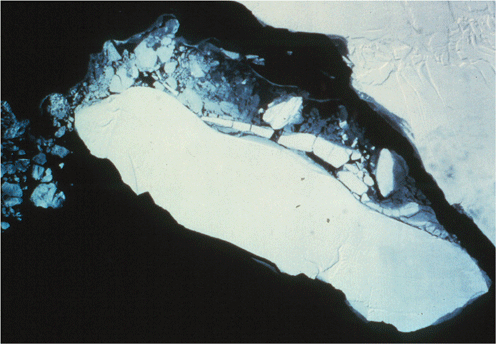
In light of such studies, the current ruthless competition between energy and food markets, amplified by international speculation in commodities and agricultural land, is only a modest portent of the chaos that could soon grow exponentially from the convergence of resource depletion, intractable inequality, and climate change. The real danger is that human solidarity itself, like a West Antarctic ice shelf, will suddenly fracture and shatter into a thousand shards.

Mike Davis is the author of In Praise of Barbarians: Essays against Empire (Haymarket Books, 2008) and Buda's Wagon: A Brief History of the Car Bomb (Verso, 2007). He is currently working on a book about cities, poverty, and global change.

[Note for TomDispatch readers: Those of you who are environmentally minded and interested in pursuing such matters further might consider spending some time at the superb website of Grist Magazine and visiting, as well, an interesting and provocative new online magazine/website, Environment 360. Tom]

Copyright 2008 Mike Davis